A good name story does not have to be grand
Use family, place and memory to narrow a name list without giving a child someone else’s life to carry.
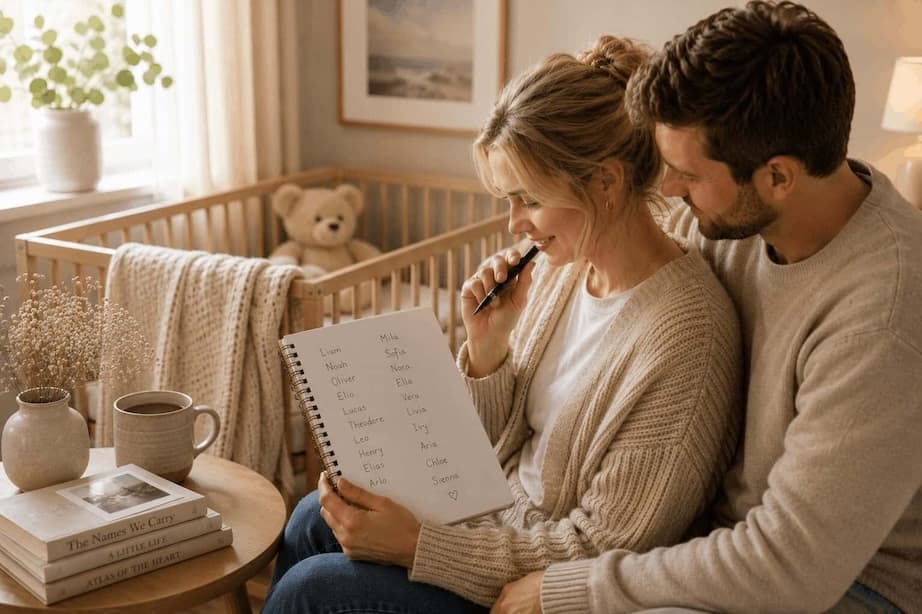
A long list of names can become harder to use the longer you look at it. Popularity, spelling, meaning and other people’s opinions all compete for attention. One way to make the list manageable is to ask a different question: why would we choose this name?
The answer does not need to be impressive. “We both liked saying it” is a perfectly good reason. So is a family connection, a place, a book or a person you remember fondly.
Look for a connection, not a perfect story
A name can remind you of a grandparent without being exactly the same name. It can borrow an initial, use a related form or sit in the middle-name position. A place name may matter because you met there, not because the place has any formal connection to the child.
The useful part of a story is that it helps you understand your own preference. If you like Alma because it was your great-grandmother’s name, that tells you something different from liking Alma because it is short and works in two languages. Both reasons are valid, but they may lead to different alternatives if Alma itself does not work.
Try finishing one sentence for every serious candidate:
“We are considering this name because…”
If the sentence is specific, the name probably has a real place on the list. If the answer is only “it is popular” or “everyone else likes it,” it may be worth asking whether the name is there for you or for the audience around you.
Do not turn an honour name into an obligation
Family names can be warm, but they can also come with pressure. Wanting to remember someone and feeling required to use their name are not the same thing.
Before choosing an honour name, discuss what exactly you want to preserve. Is it the person, the sound, the cultural connection or the family tradition? Once that is clear, there may be several good options: the original name, a variant, the same initial or a middle name.
It is also reasonable to decide that the connection is too complicated. A child’s name should not be used to settle an old family disagreement or fulfil an expectation nobody has openly discussed.
Check that the story still leaves room for the child
A meaning such as “brave” can be lovely, but it is not a job description. A child named after an admired relative does not have to resemble that person. The story should explain why you chose the name, not tell the child who to become.
Ask how you would tell the story in a few years. A comfortable version sounds like: “We chose your name because it reminded us of someone kind.” A heavier version sounds like: “We chose it because we expect you to continue what that person started.” The first gives context. The second gives the child an assignment.
Compare the reasons as well as the names
When two or three candidates remain, write one honest sentence for each. Then compare the sentences.
- Which reason still matters if the name moves up or down a popularity list?
- Which connection would you enjoy explaining to the child?
- Which name works in daily life as well as in the story?
- Are you both choosing it freely?
The winning name does not need the oldest history or the deepest meaning. It needs a reason you recognise as your own and a sound you are happy to use every day.
One day the child may ask why you chose it. A clear, ordinary answer is more useful than a perfect legend.